
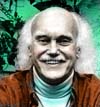
 “Be A Soul” The Innerview with Ram Dass by Peter Moore
Ram Dass has led the life of seeker and traveler, teacher and social activist for 45 years. The quality of his conscious-ness is legendary, not only for the words spoken, but because of the spell that is somehow invoked in his company.
Ram Dass is well known for his experimentation with LSD and his anthem book of the late ’60s “Be Here Now”. But his life works include much more than these. Early on he created the Prison Ashram Project, introducing deep spiritual work in prison. To the taboo surrounding death & dying in this culture, he responded with the Dying Project, introducing dying people to other planes of consciousness. Noticing the need to combine social action with spiritual motive, Ram Dass co-created the Seva Foundation, working with doctors and activists in India, Nepal, Guatemala and here in the US. He’s worked with business people in the Social Venture Net-work, and with Creating Our Future, a spiritually questing organization for teenagers, among many other causes. The common theme in all of these projects has been the application of spiritual princi-ples to social realities.
Five years ago Ram Dass suffered a massive stroke. He is in his wheel chair a lot and has speech aphasia, so there is more space between his words now, and the occasional unfinished sentence. I found that the silences threading through his spoken words gave me time to dream into our conversation—which may sound weird but was quite profound. I interviewed Ram Dass on July 29 at Breitenbush Hot Springs.
PM: The last time I saw you, you said: “Peter, be a soul.”
RD: Ah, that’s interesting...
PM: That was two years ago, right here at Breitenbush. What did you mean by that?
RD: We have a choice as to who in ourselves we want to identify with. Both soul and ego...and a third one... are all going on, all the time, in every human being. But you can identify only with one of them, and then you’re blind to the others. They are treated as static. I was saying to shift your identification, because the only motive a soul has is to satisfy God…or to become one with The One... it’s being One with the Beloved. That’s the ultimate goal.
PM: The ultimate goal?
RD: So that’s what I wanted you to focus on, and then your life becomes ... your incarnation becomes ... a step on this journey, and it’s nothing more than that. OK?
PM: OK.
RD: Yeah.
PM: Many questions arise ...
RD: Yeah, I bet. (laughter)
PM: What journey do you speak of? Are you talking about past lives, future lives, a whole set of reincarnations, and that’s what this one is?
RD: Yes.
PM: In a word … (laughing)
RD: Yes.
PM: OK.
RD: I have bought reincarnation.
PM: Tell me about that ...
RD: I bought it from Maharaji, from books, from holy writings, my own intuition...
PM: When you were a Harvard profes-sor, 40 years ago, had you bought it then?
RD: No. No. I wasn’t even open to it.
PM: So, you’ve journeyed far this life.
RD: Yeah. Because mushrooms and LSD, plus Maharaji led me to shift perceptions to the universe about me.
PM: And those perceptual shifts weren’t ephemeral? They didn’t just fade away like a mirage after the mushrooms, LSD and Maharaji experiences occurred?
RD: No. No. They filled a need in me. That need was for truth, for compassion, for wisdom, for the Beloved. I wanted to merge with the Beloved. I wanted to be the Beloved, I guess. And, those two things, the psychoactive drugs and Maharaji, they told me of this need. All my life up to that point was like, mind going blindly, thinking that worldly ecstasy was divine.
PM: (laughter) So in fact, it was the worldly ecstasy, not the drugs, that ends up being the ephemeral experience.
RD: Yeah.
PM: Regarding LSD, mushrooms and direct spiritual experience: you put your Harvard career on the line over these issues back in the ’60s. Do you view these kinds of psychonautical experiences, particularly the drug experiences, as still relevant for a person?
RD: Yes.
PM: Yes?
RD: Yes. But not for all people. I mean, like, medication is relevant, but not for all people, because of their chemical makeup, or their mindsets, or their environment.
PM: Is the choice to use these kinds of substances to be left to the individual ...
RD: ...to the individual…
PM: ...or to the state?
RD: No… (laughing)
PM: (laughing... How’s that for a rhetorical question?)
RD: THE STATE, of course! (Much laughter)
PM: (We’ve got it on tape!)
RD: The individual, of course. I am part of the Drug Policy Alliance, directed by a VERY smart guy, Ethan Nadelmann. He was a professor at Princeton, and then he was selected by George Soros to direct this group. Nadelmann is the point man against the current War on Drugs policy, and its effects—the state prohibition against marijuana, the prison-industry connection, the link between differential enforcement of these laws and racial injustice, mandatory sentencing—the whole gamut... Nadelmann directs an international effort to expose this war on drugs for what it is, and to change these prohibitionist policies. Ethan is talking about harm reduction—an important concept. I back him, just all the way.
PM: Talk to me about your own use.
RD: First of all, I use medical marijuana for my stroke…to control spastic movements, and for pain. These are my legal reasons for using. But that’s the minor use of it. More important, I use marijuana because the stroke captures my consciousness—and I use it to free my consciousness from the stroke. I use it to free my words.
PM: And it works?
RD: And it works. It works. So that’s Mother healing... healing deeply.
PM: We are seeing some progress with medicinal marijuana in Oregon and California, but the feds are heavy handed...
RD: Heavy...
PM: ... in coming after it. Do you think this is the darkness before the dawn? Are these prohibition laws ever going to go away?
RD: If you look at Europe, England has just legalized ...
PM: and Portugal...
RD: and Portugal. I think it’s darkness before the dawn, because the next evolution is going to be a consciousness evolution instead of a communication revolution ... it’s going to be ... we are going to acknowledge that which is in our interests, but is not separate...
PM: Let’s see if I get this straight...
RD: (laughs)
PM: In the last 10,000 years humanity’s gone through a succession of evolutionary stages—the agricultural revolution, the development of city-states, then nation states & stratified societies & class systems, leading to the middle class melting pot, and the revolutionary ideals of equality and democracy. We’ve had the industrial revolution, and the communications revolution...
RD: Yeah...
PM: ...and you are predicting that beyond the communications revolution there’s going to be a ...
RD: …A Oneness.
PM: A Oneness?
RD: A Oneness of all. An evolution in consciousness of us all that isn’t about the egos. It overrides the United Nations, because the United Nations is a collectivity of egos, and you don’t want ... big egos.
PM: What about corporate states? The concentrated powers of transnational corporations.
RD: They’re the next evolution in the bad guys... (laughter fills the room)
PM: At the Oregon Country Fair, you said, “Hold George W. Bush in your heart.” Do you hold him in your heart with affection?
RD: ...No. …No. I see him as a fellow soul. And I don’t…affection is too psychological of a word. I mean, I have opened ... with love. Which is the most I can do to help him through his incarnation. Which is what one soul can do for another soul.
I’ve been pushing an idea that the major institution for social change is the human heart. And social change—the social change that matters—comes heart to heart. I am talking about the heart to heart resuscitation of society. It throws people back to themselves, changes attitudes, and that’s what brings together social action. Social activism and spiritual practice.
PM: The Hindu, Yogic tradition is founded, as I understand it, on right Discernment and Dispassion. The two dis’s. Discernment: right judgment, right thought, right awareness and perception. I can relate to discernment. But I’m not good at dispassion. I feel enormous passion about corporate theft and military murder and environmental destruction, and...
RD: The question is, do you want more to express your angst, or do you want more to change the conditions that are creating it?
PM: I’m listening…
RD: If you want more to change it, you’ve got to be dispassionate and discerning.
PM: OK. Help me here. Today’s news from NPR and USA Today is that it looks like the invasion of Iraq is on. They want to put 200,000 US troops on the ground and “liberate” Baghdad, to install a regime the USA approves of. My initial response is to publish a warning poster in Alternatives, with George W.’s face on it, like an FBI “Terrorist Alert”. …Is there a more dispassionate course for me to take?
RD: …That course fires the passions—but it does so with humor. And humor is the spiritual stuff in that mix. So, that would be good to do, I think... Dispassion guides you to skillful means. You can do that, with George Bush in your magazine, and I can have his picture on my Puja table......they’re both doing the same thing.
PM: I love it! So I’m gonna put that poster in the middle of your interview.
RD: You are? (laughter)
PM: We’ve talked about the War on Drugs. What about this “War on Terrorism”? For a peacefully inclined person, what is the best action—or non-action—to take, to lessen terrorism in the world?
RD: I saw a sign in a tenement window in Chicago. It was a red sign with black lettering and it said, “Stop Terror.” That’s all. And I thought....to stop terrorism you’ve got to stop terror. You’ve got to have a population who are not terrified to stop terror.
PM: How close do you think our population in the United States is?
RD: Not ... but, I would like to invite the populace to look within, to a place where they are peaceful and they’re in a peaceful universe. That would be a population that would not be stopped with terror. Because, like, death is terror. Death’s the basic card. But souls aren’t terrified of death.
PM: Back to “be a soul…” (laughter)
RD: I was giving a talk in Los Angeles, and Laura Huxley asked a question: “what would you say to both sides, Arab and Israeli?”...and I said. …I’d say to them, “One God”.
They’re both talking about “their God”, based on a few miswritten mystics. So we got two mystics, with two takes of God…and that’s what we’re fighting for. Now I would say to them: with this conflict you are shooting yourself in the foot. Your resources… your manpower… your culture…
PM: What about 911?
RD: I saw September 11th as a fierce grace. I see it waking people up—not just the United States, all the world. That act changed the feeling of security in the world ... because Big Brother is vulnerable.
PM: Yes, but Big Brother has also been busy. Since 911, we’ve got the Patriot Act, and now TIPS, the national snitch project to get the mailman and PGE meter readers—anybody with access to homes & offices—to spy on people. But fierce grace... You mean that, with all this darkness, you’re an optimist?
RD: Yeah, I am. There is something in humanity that goes to the brink—then pulls back.
PM: If reincarnation is true, why do we keep coming back again and again to all this?
RD: Somehow I figure that why we take incarnation is because we learn about two things in this life: suffering and love.
PM: What about ecstasy? Or, the pleasures of success?
RD: That’s the love category. Love and joy.
PM: Love and joy together. OK. How about the corporate crooks who loot their companies and steal everything from their workers and investors? Is their success and joy being deposited in the suffering category then?
RD: ...that can’t be joy. Because they know in the back of their mind how uncompassionate they are. And you can’t build joy on a feeling of self-loathing.
PM: Suffering and love... You’ve gone the Buddha one extra. He said it’s all about suffering, period.
RD: Yeah. Maharaji drove me to this. Once, this woman came before him and she said, “Maharaji, my life is so much suffering”. She was so sad ... and everybody around was so sad about her story—and then Maharaji said, “Suffering brings me closer to God”. See, suffering is because of attachment. So suffering means you better get stepping on your attachments. Therefore it’s a wake-up call to get you to God. That’s love.
PM: For the past 40 years you’ve taught and been identified with “baby boomers”. What are you seeing in the generations following, the ones that don’t necessarily identify with the sixties “revolution”. Are you talking to them, are they listening?
RD: …Rock and roll, that’s it… That’s it. It crosses generations, and it also crosses nation states…The wall came down. Before that happened, the Beatles, and the ... So, now, what was the question?
PM: The question was, what do you see with these upcoming generations? —And I liked your answer, by the way, even if it didn’t directly answer the question.
RD: For a long time I’d been thinking I was going to get old along with my audience. Now, however, I’m hearing rumblings from the high school kids. They want to know what happened in the sixties. They want to…they want a spiritual life.
PM: So it’s perennial, not just generational! I once heard Newt Gingrich say that the sixties was an “aberration of history”. He inferred that teachers like you, the anti-war movement, experimenting with consciousness—was a mutation, but it’s over now, the country is back on track, doing what’s good for business. Do you think it was an aberration of history?
RD: No. It was a corrective mechanism.
PM: Thank you for setting the record straight! Speaking of the sixties, what got you going to India from Harvard?
RD: I was bored at Harvard. The guy down the hall was more interesting than most at Harvard. He taught me to function in a way at odds with the society. He was the Irish taking on the English. He had cultural stuff about him...
PM: ...he was a warrior ...
RD: ... yeah, but I couldn’t follow him to the letter. The psychedelics allowed me to touch the still small voice within me—the God within me. Then I wondered what to do with that. My psychology wasn’t a map for this territory. So I decided I had to go and look for maps. Then Aldus Huxley, a colleague at MIT, gave me one. He gave me the “Tibetan Book of the Dead”. I remember, I had had an LSD session on Saturday, and Huxley gave me this book on Tuesday. And in the book were descriptions of my session on Saturday. They were accurate, down to minute details…so I knew that drugs were on to something. But then I knew that “they”, meaning the people from the Far East, have the maps that we don’t have, because they’ve been studying the territory for so long. So I went to the East to find a teacher, because I figured my ability to read these maps is curtailed by my cultural training, and I need to find a “reader” of these maps. And Maharaji was who I came to next. Maharaji from then on guided me, because from then on I am living his business. Okay? I am. He’s responsible.
PM: His business…well, you’ve been giving out these same maps to millions of others for 35 years. You’re a “reader” of these psychonautical maps for others, just as Maharaji was for you.
RD: Yeah. That’s just a sort of personality thing.
PM: (laughing) well, how perfect...
RD: Yeah, it is perfect. See, Maharaji saw that in me.
PM: I get it.
RD: You know, when I left India the first time, Maharaji said “You are not to speak about me.” ...but I did. Now, that’s interesting, because I couldn’t let that information go when it would help people.
PM: So “his business” has impelled your life’s work. What’s your work now?
RD: I am exploring my own dictum. ‘Be Here Now’. That’s what I’m doing these days. And I’m having lots of trouble.
PM: Really? I thought you were going to say you are having lots of fun!
RD: Oh, well, it’s lots of fun, but, trouble too, because, to be here and now, I have to break time-binding. Everybody and all things are a playground, and I am driving myself crazy because ... and this is over simplistic, but ... I go out for two weeks, and then for two weeks I’m home. The two weeks I’m home, I’m yearning for freedom, just yearning for it…just luxuriating…just, freedom…here, and here, and here, all the baklava, you know... and, that time is like a temple, it’s my temple…. Then the next period starts up and it’s about, you know, “hurry up, we’ve got to…”, and, “is the coffee ready?” I can make the shift, but, those shift periods ...
PM: Demanding!
RD: Demanding. But, I have a beautiful, big picture window at my desk, and it’s got the bay, and the mountains, and the sky, and the clouds, and the trees, and the birds, and everything out there—and I sit, I sit looking out the window. That’s my whole occupation…because I’m contemplating. I’m meditating ... I do that, you know, and I’m going like, like the birds, you know…with my consciousness. I love that freedom. I love it. I’m addicted to it! But it’s hard to get the horse ....
PM: (laughing) ... out on the road again? ... but see, you do it, even if it’s hard! I mean, you’re here!
RD: Yeah. Yeah. We all have these things...and what I’m doing, I’m teaching these two planes at once, two planes at once. It’s a karma yoga.
PM: It’s a gift. In your touring out, I’ve noticed for years that you show up at events like the Rainbow Gathering, the Oregon Country Fair, and here at Breitenbush. Why these events and places?
RD: These fairs and gatherings, they are where America’s sadhus come together. They are the Kumbha Melas of our culture.
PM: The Kumbha Melas of America. (laughing) What a great parallel!
RD: ...I do know why I go to the Rainbow Gathering and these other events... they’re my people.
PM: You come as a giver, a teacher—but you’re saying that the quality of what you receive is important too?
RD: Yes. Yes. Very much. Those festivals feed me tremendously.
PM: You’ve spoken of planetary things, like the next evolutionary stage, and of local things, like these gatherings. What is the relationship between them? RD: These gatherings, and what you here at Breitenbush are doing, it’s the right thing... This is what a thoughtful heart does under these conditions. And it’s true, these little, little, little things ...beautifully add up.
Ram Dass lives in Marin County, California. If interested in more about Ram Dass, his life and times, an extensive collections of interviews, tapes and videos are available online. You might start with the Ram Dass Tape Library Foundation - www.ramdasstapes.org